AI-Augmented Consulting
Published Updated
How small engineering teams deliver enterprise systems faster
Executive Summary
Enterprise software consulting has been sold by headcount for decades. The model is familiar to procurement, easy to invoice, and deeply embedded in how agencies and corporations budget for IT delivery. It is also increasingly disconnected from how software actually gets built.
AI-augmented consulting does not replace engineers. It changes the economics of what a small, experienced team can deliver. When AI tooling is integrated across the full software development lifecycle — from requirements through testing, documentation, and knowledge capture — a three-person team with strong technical judgment can match or exceed the output of a traditionally staffed engagement ten times its size.1
This guide explains what AI-augmented consulting means in practice, how to structure a delivery team around it, where the model breaks, and what buyers evaluating proposals should look for. The examples draw from enterprise custom development — APIs, server-side services, databases, and front-end components — with SharePoint and the Microsoft ecosystem as a recurring reference point, though the delivery model applies to any platform where disciplined engineering matters more than headcount.
The Problem: Why Traditional Consulting Delivery Is Breaking
The headcount model and its incentives
Most consulting engagements are scoped in labor categories. A requirements phase staffed with business analysts. A development phase staffed with developers, a tech lead, and a project manager. A testing phase staffed with QA engineers. An operations handoff staffed with documentation specialists. Each phase adds bodies. Each body adds billable hours. The proposal looks thorough. The staffing plan fills a spreadsheet.
The model persists because it is legible. A contracting officer can compare two proposals by counting FTEs and matching labor categories to a price matrix. A program manager can report progress by tracking how many people are on the contract this quarter. The system optimizes for inputs — hours billed, seats filled, roles staffed — because inputs are easier to measure than outcomes.
But legibility is not the same as effectiveness. The Government Accountability Office has tracked federal IT acquisitions as a high-risk area since 2015. As of January 2025, 463 of the 1,881 recommendations GAO has made to agencies on IT management remain unimplemented.2 The federal government spends more than $100 billion annually on IT, with roughly 80% going to operations and maintenance of existing systems rather than modernization.3 The spending is enormous. The results are not proportional.
The gap between team size and delivered value
Large teams create coordination overhead that directly competes with delivery. Every additional person on a project introduces communication paths, handoff points, and opportunities for misalignment. A ten-person team has 45 potential communication channels. A three-person team has three.
The Standish Group's research on IT project outcomes has consistently found that smaller projects succeed at dramatically higher rates. Small projects achieve approximately 90% success rates. Large projects — particularly those exceeding $10 million — succeed less than 10% of the time.4 Project size is not the only factor, but it is a reliable one. Smaller teams working on smaller increments, with shorter feedback cycles, consistently outperform large teams working on large scopes with extended timelines.
This is not a new observation. What is new is that AI tooling has shifted the boundary of what a small team can credibly take on. Tasks that previously required dedicated staffing — writing unit tests, generating documentation, reviewing code for common patterns, drafting requirements specifications — can now be handled by the same engineers doing the core development work, with AI acceleration reducing the marginal cost of each task to near zero.
What buyers actually need
The buyer — whether a federal IT director, a commercial CTO, or an agency contracting officer — does not need 15 people on a contract. They need working software deployed to production. They need confidence that the system will behave correctly under real conditions. They need documentation sufficient for a new team to maintain the system after the engagement ends. They need an audit trail showing what was built, why decisions were made, and who approved what.
These are outcomes. The headcount model conflates the means of delivery with the outcomes of delivery, and the distinction matters. AI-augmented consulting redraws the line between the two.
What "AI-Augmented" Actually Means
Defining the term — and separating it from the hype
AI-augmented consulting is a delivery model in which experienced engineers use AI tooling at every stage of the software development lifecycle to move faster, catch more defects, and produce comprehensive documentation as a byproduct of the development process itself. It is not a marketing label for teams that use GitHub Copilot's autocomplete. It is not a claim that AI builds the software.
The distinction matters because the phrase "AI-augmented" has been diluted by teams and vendors who use it to describe ad-hoc prompting layered on top of an otherwise unchanged development process. That is not augmentation. That is autocomplete with better suggestions.
Genuine augmentation means AI is embedded in the pipeline — not as an optional accelerator, but as a structural component of how requirements are reviewed, how code is generated and validated, how tests are written, and how institutional knowledge is captured. The humans on the team make every consequential decision: what to build, how to architect it, whether to ship it. The AI handles the repetitive, parallelizable, and documentation-heavy work that traditionally consumed the majority of an engineering team's time.
There is a persistent anxiety that AI will replace software developers. It will not — at least not the ones whose value comes from judgment, architectural reasoning, and client-context awareness. What AI does replace is the need to staff a team with people whose primary job is to produce volume: volume of tests, volume of documentation, volume of boilerplate code. Those tasks are now handled by the pipeline. The engineers who remain are the ones who decide what the pipeline should produce.
The full pipeline — where AI shows up
In a disciplined AI-augmented delivery model, AI tooling is present at every stage. The specific tools matter less than the coverage, but naming them establishes credibility and gives buyers something concrete to evaluate.
Requirements and documentation. Large language models excel at structured document generation, gap analysis, and requirements review. Claude, ChatGPT, Gemini, and Grok can all draft a requirements specification from a stakeholder interview transcript in minutes. More importantly, these models can review a requirements document and identify ambiguities, conflicts, and missing acceptance criteria that a human reviewer might overlook on first pass. The generation is fast. The review is where judgment lives, and AI makes review faster by surfacing the issues rather than requiring the reviewer to hunt for them.
Code generation and review. Cursor, GitHub Copilot, and Google's Gemini Code Assist provide inline code generation within the IDE. Claude and ChatGPT provide architectural review, refactoring suggestions, and pattern-level analysis across larger codebases. OpenAI's Codex powers automation workflows for repetitive transformations. The developer works with AI-generated code the same way a senior engineer works with code written by a junior developer: review it, test it, understand it, then decide whether to commit it. The AI proposes. The human disposes.
In practice, this means the AI can generate API endpoint scaffolding, database query logic, React component boilerplate, server-side service implementations, and integration layer code in seconds. The developer's job is to evaluate whether the generated code respects the target platform's constraints — rate limits, authentication models, data access governance, and the architectural decisions already made for the project. Speed without judgment is reckless. Speed with judgment is leverage.
Testing and QA. This is where AI augmentation produces its most measurable impact on team composition. Testing has traditionally been the phase that either requires dedicated QA staffing or gets shortchanged when schedules compress. AI-generated unit tests, integration test scaffolding, and edge case identification change that equation.
Consider a concrete scenario drawn from real engagement experience: a developer on a small consulting team is strong on API design, backend logic, and database optimization but has historically struggled with front-end unit testing for React components. In a traditional staffing model, this skill gap gets addressed by adding a QA engineer to the team or by accepting thin test coverage and absorbing the risk. Neither is a good answer.
In the AI-augmented model, the developer describes the component behavior. The AI generates the test harness — Jest configuration, React Testing Library setup, mock scaffolding, assertion structure. The developer reviews the generated tests, adjusts for business logic specifics, and runs them. Test coverage goes from 15% to 80% or higher without adding a person to the team. The skill gap did not require a hire. It required tooling.5
Knowledge capture and institutional memory. This is the least discussed and most strategically significant application of AI in consulting delivery. Engineering directors and program managers across industries live with a persistent nightmare: the lead developer leaves, and the institutional knowledge walks out the door. The next team spends months re-learning decisions that were never documented.
AI-augmented pipelines produce documentation as a byproduct, not an afterthought. Decision logs captured automatically. Dev journals generated from commit histories and code review conversations. Architecture decision records drafted by the AI and reviewed by the engineer. Context preserved in queryable formats — not buried in someone's email or stored in a departing contractor's head.
When a program manager can ask "why was this caching strategy chosen?" and get an answer from the project knowledge base rather than from a person who may no longer be on the contract, that is not a convenience. That is a structural improvement in how institutional knowledge survives team transitions.
What this looks like in practice
The visual signature of an AI-augmented team at work looks fundamentally different from a traditional development environment. The screen shows a terminal with AI agents running alongside the IDE. A build compiling in one pane. AI-generated code under review in another. API tests executing against a staging environment. Documentation generating in the background.
This is not a demo. It is a workday. The AI tooling is not being showcased — it is being used, the same way a carpenter uses a power saw. Present, integrated, and unremarkable to the person using it. The audience that matters — the program manager watching a capability demonstration, the CTO evaluating delivery models — sees a disciplined pipeline, not a technology demo.
The Framework: Judgment-Led, AI-Accelerated Delivery
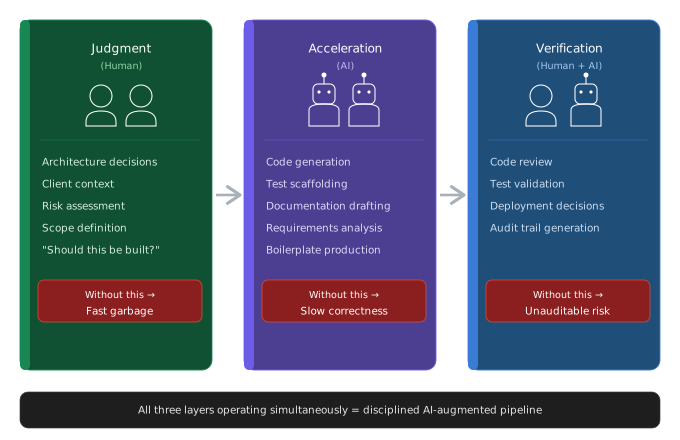
The mental model
The delivery model has three layers. All three must be present. Removing any one of them produces a dysfunctional pipeline.
Judgment layer (human). Architecture decisions, client context, risk assessment, governance, scope definition, and the fundamental question: should this be built at all? No AI tooling replaces the engineer who has spent fifteen years learning which abstractions hold up under production load and which ones look elegant in a demo and collapse at scale. The judgment layer is where experience lives.
Acceleration layer (AI). Code generation, test scaffolding, documentation drafting, requirements analysis, pattern detection, boilerplate production — everything that is repeatable, parallelizable, and benefits from speed. This layer is where AI tooling earns its value. The tasks are real work. They consume real time in traditional engagements. And they can be performed by AI at a fraction of the cost and time, provided the output is reviewed.
Verification layer (human + AI). Code review, test validation, deployment decisions, audit trail generation. This layer is bidirectional: humans verify what AI produced, and AI helps humans verify what humans produced. A code review that includes AI-generated analysis alongside human review catches more than either alone. A test suite that includes AI-generated edge cases alongside human-designed scenarios covers more surface area.
Why the layers matter
Without the judgment layer, you get fast garbage. The AI generates code at high speed with no one evaluating whether the architecture is sound, the approach is appropriate for the client's environment, or the feature should exist at all.
Without the acceleration layer, you get slow correctness. The engineering is sound but the delivery timeline is measured in the same months-long cadences that have defined enterprise consulting for decades. The team is competent but not leveraged.
Without the verification layer, you get unauditable risk. Code ships without review. Tests run without validation. Documentation exists but nobody confirmed it matches the actual system. In a commercial engagement, this creates technical debt. In a federal engagement, it creates a compliance liability.
The model requires all three layers operating simultaneously. This is what separates a disciplined AI-augmented pipeline from a team that installed Copilot and updated their capabilities brief.
How this maps to enterprise custom development
Consider a concrete example: building a data aggregation service that pulls from multiple APIs across organizational boundaries, normalizes the data into a unified schema, and surfaces it through both a web front end and a REST endpoint for downstream consumers. This is a common pattern in large enterprises and regulated industries where organizational structure creates data silos that users and systems need to see through. In the Microsoft ecosystem, this might be a SharePoint-based solution querying across site collections via Microsoft Graph. In a healthcare or financial services environment, it might be a Node.js service federating data from multiple internal systems behind an API gateway.
Judgment layer: The lead architect evaluates the client's system topology, determines the integration approach (direct API calls vs. an intermediary data layer), assesses performance implications of cross-boundary queries, and decides on authentication and authorization strategy based on the target environment's governance posture.
Acceleration layer: The AI generates the API service scaffolding, data transformation logic, React front-end components, database migration scripts, and unit test harness. It drafts the architecture decision record documenting why the chosen integration pattern was selected over alternatives. It produces the API documentation and deployment guide.
Verification layer: The engineer reviews every line of generated code against platform constraints — rate limits, authentication token lifecycle, data residency requirements, and cross-system permissions models. The AI-generated tests are validated against real data. The architecture decision record is reviewed for accuracy and completeness before being committed to the project knowledge base.
The output is the same as what a traditional team would produce. The team that produces it is smaller, faster, and generates better documentation as a structural byproduct of the process. The consulting model shifts from selling hours to delivering capability.
Implementation: Standing Up an AI-Augmented Delivery Team
Team composition
An AI-augmented delivery team for enterprise custom development looks nothing like a traditional staffing plan. A credible team for a mid-complexity engagement — a multi-service API platform, a data integration layer, a custom web application with database and front-end components — consists of three people:
A lead architect and engineer who owns architecture decisions, client relationships, and final approval on all code that ships. This person has deep platform expertise, understands the client's environment, and carries the judgment that the AI cannot replicate. This role is not optional and cannot be staffed with a junior engineer regardless of how good the AI tooling is.
A mid-level developer who handles day-to-day implementation, works directly with AI code generation tools, and executes within the architectural boundaries set by the lead. This person writes code, reviews AI-generated code, and runs the test-and-deploy cycle. AI augmentation makes this developer significantly more productive, but the person needs to be competent enough to evaluate what the AI produces.
A QA and documentation specialist who validates test coverage, reviews AI-generated documentation, and maintains the project knowledge base. In a traditional model, this role would be split across two or three people — a dedicated QA engineer, a technical writer, and possibly a configuration manager. AI tooling compresses these functions into a single role focused on verification and quality rather than production.
Compare this to the traditional staffing plan for equivalent scope: a project manager, a business analyst, a tech lead, three to five developers, a QA lead, one to two QA engineers, and a technical writer. Ten to twelve people, most of whom spend significant portions of their time in meetings, writing status reports, or waiting for dependencies.
The three-person team is not a compromise. It is a structural advantage. Fewer communication channels. Faster decision cycles. Every person on the team touches the work directly. There is nowhere to hide and no one whose primary output is coordination rather than delivery.
Toolchain setup
The toolchain is specific, named, and integrated. Ambiguity about tools signals ambiguity about the delivery model.
IDE layer: Cursor, VS Code with GitHub Copilot, or JetBrains with AI Assistant. This is the developer's daily environment. Code generation happens inline, at the point of implementation. Cursor provides deep integration with Claude for larger-context reasoning across files. Copilot provides fast, token-level completion for boilerplate and pattern matching. Google's Gemini Code Assist offers similar inline capabilities with strong integration into Google Cloud workflows. The choice depends on the developer's workflow, the target platform, and the complexity of the codebase.
Review and reasoning layer: Claude, ChatGPT, or Gemini. The reasoning layer serves as the second pair of eyes with deep context. It reviews code for architectural consistency, identifies potential issues across file boundaries, analyzes requirements documents for completeness, and generates structured documentation from technical specifications. Claude and ChatGPT both excel at this when given sufficient project context. The key is not which model — it is whether the team has engineered persistent context (project files, architectural standards, coding conventions) so the model operates with full awareness of the project, not from a blank slate.
CI/CD integration. AI-assisted build validation and automated test generation are part of the pipeline, not afterthoughts bolted on before release. Test generation happens at the point of code creation, not as a separate QA phase weeks later. Build validation includes AI-generated checks for common deployment issues specific to the target platform — API versioning conflicts, permission scoping, infrastructure-as-code drift, and dependency compatibility.
Knowledge management. AI-generated dev journals, decision logs, and architecture records are stored in queryable formats. The project knowledge base is not a SharePoint document library full of Word documents that nobody reads. It is a structured, searchable repository that a new team member — or the client — can query directly. "Why was the Graph API chosen over the Search API for this component?" should return a documented answer, not a shrug.
Process changes
The daily rhythm of an AI-augmented team differs from a traditional engagement in specific, measurable ways.
Sprint planning incorporates AI capacity explicitly. A task that would take eight hours of manual implementation might take two hours with AI code generation plus review time. The planning acknowledges this — not by assigning more tasks, but by allocating the recovered time to verification, testing, and documentation. Speed is not the goal. Throughput of verified, documented, tested software is the goal.
Code review includes AI-generated analysis alongside human review. The AI flags potential issues, suggests refactoring opportunities, and checks for patterns that violate the project's architectural standards. The human reviewer evaluates the AI's suggestions and makes final decisions. This dual-review model catches more issues than either review source alone.
Documentation is a pipeline output, not a Friday afternoon chore. Every significant code change generates a corresponding update to the project knowledge base. Architecture decisions are recorded at the point of decision, not reconstructed from memory weeks later for a deliverable nobody will read until the next team inherits the project.
Testing coverage targets become achievable because the bottleneck shifts. The constraint is no longer "we don't have enough time to write tests." The constraint becomes "we need to validate that the AI-generated tests actually exercise the right business logic." This is a better constraint to have. It means the team is evaluating test quality rather than debating whether tests should exist at all.
An end-to-end example
A mid-size healthcare organization needs a data integration service that consolidates scheduling information from three separate line-of-business systems, exposes it through a REST API for downstream consumers, and renders it in a SharePoint-hosted front end for clinical and administrative staff. The service must handle authentication across system boundaries, normalize inconsistent data schemas, and deploy to a managed environment with strict compliance requirements.
Traditional approach: An eight-person team scopes a twelve-week engagement. Requirements gathering takes three weeks. Development takes six weeks. Testing and documentation take three weeks. Total cost: approximately $350,000 at blended consulting rates. Test coverage: variable, typically 30-40% for front-end components. Documentation: a 60-page Word document delivered at project close.
AI-augmented approach: A three-person team delivers in four weeks. Requirements are drafted with AI assistance and validated with the client in week one. Core development and concurrent test generation happen in weeks two and three. Integration testing, documentation finalization, and deployment happen in week four. Total cost: approximately $75,000. Test coverage: 80%+, including AI-generated edge case scenarios. Documentation: continuously generated throughout the engagement, queryable, and maintained in the project knowledge base.
The cost difference is significant. The quality difference — in test coverage, documentation completeness, and time to production — favors the smaller team. The reason is not that the three-person team works harder. It is that the AI-augmented pipeline eliminates the work that existed primarily to keep a larger team busy.6
Common Failure Modes
AI-augmented delivery is not immune to failure. The failure modes are different from those in traditional consulting, and some of them are novel enough that teams encounter them for the first time.
"I'm good with prompting" is not a strategy
The most common failure mode is treating AI interaction as an ad-hoc skill rather than an engineered system. A developer who writes good prompts in a chat window is not operating an AI-augmented pipeline. They are having a conversation.
Disciplined AI augmentation requires persistent context. In Claude Code, this means maintaining a CLAUDE.md file — a project-level configuration that provides the AI with architectural standards, coding conventions, common commands, and project-specific constraints.7 It means using skills — structured instruction sets that teach the AI how to perform specific tasks within the project's framework in a repeatable manner.8 OpenAI's ecosystem has analogous patterns: custom GPTs with persistent instructions, the Assistants API with file-backed context, and Codex configurations that carry project awareness across sessions. Google's Gemini supports system instructions and grounded context in similar ways. The specific platform matters less than the principle: the AI must start every interaction with the project's full background, not a blank slate.
The difference between a team that prompts well and a team that has engineered their AI context is the difference between a developer who writes good code in a text editor and a developer who has configured their IDE, linter, CI pipeline, and test framework. The former works. The latter scales.
Teams that skip this work — that rely on individual prompting skill rather than systematic context engineering — end up re-explaining the project to the AI on every interaction. They lose time to redundant setup. They get inconsistent outputs because the AI lacks persistent awareness of prior decisions. And they cannot onboard a new team member into the AI workflow because the workflow exists only in one person's prompting habits, not in a documented system.
Skipping the verification layer
The speed of AI-generated code is intoxicating. A component that would take four hours to write appears in thirty seconds. The temptation to commit it without thorough review is real, and the consequences are predictable.
AI-generated code can be syntactically correct, functionally reasonable, and architecturally wrong. It may use an API pattern that works in a test environment but violates rate limits in production. It may implement a caching strategy that conflicts with the client's data freshness requirements. It may handle authentication in a way that passes unit tests but fails under the target environment's conditional access policies or zero-trust architecture.
Every line of AI-generated code must pass the same quality gate as human-written code. The origin of the code does not change the standard. Teams that relax review standards for AI-generated code because "the AI is usually right" are building technical debt at machine speed.9
Treating AI as a headcount replacement instead of a force multiplier
The wrong conclusion from this delivery model: "AI writes code, so we need fewer developers, so we'll hire cheaper developers and let the AI do the heavy lifting."
The right conclusion: "AI handles the repetitive implementation work, so our developers spend more time on architecture, client context, verification, and decisions that require judgment. We need fewer people, but we need better engineers, not cheaper ones."
A junior developer with excellent AI tools and no architectural judgment will produce large quantities of plausible-looking code that does not hold up in production. The AI accelerates whatever the developer is capable of — including mistakes. If the developer lacks the experience to evaluate the AI's output, the pipeline produces defects at scale.
No knowledge capture
Using AI for delivery speed without using it for institutional memory is a missed opportunity that borders on negligence. AI-generated documentation, decision logs, and dev journals are nearly free to produce. The marginal cost of capturing "why this approach was chosen" at the moment of decision is close to zero when the AI is already part of the workflow.
Teams that skip knowledge capture gain speed during the engagement and leave the client with the same problem they had before: a system that nobody can explain six months after the team that built it moves on. In any organization with contractor turnover — government, enterprise, nonprofit — this is not just inconvenient. It is a recurring source of project failure, and it is entirely avoidable with the same AI tools already being used for development.
Ignoring governance and auditability
In regulated environments, the audit trail is not optional. Federal engagements require it — FITARA mandates that agency CIOs evaluate and oversee major IT investments.10 But the same principle applies in healthcare (HIPAA), financial services (SOX, FINRA), and any organization with compliance obligations. Contractors and vendors delivering custom development must demonstrate that their process is disciplined, documented, and auditable.
If the delivery team cannot show what was generated by AI, what was reviewed by humans, who approved the deployment, and where the architectural decisions are documented, the speed advantage becomes a compliance liability. The pipeline must produce receipts. Every commit, every review, every deployment decision should be traceable. AI tooling makes this easier, not harder — but only if the team configures the pipeline to capture it.
Real-World Scenario: The Testing Gap
The following scenario is a composite drawn from real engagement experience. The details have been generalized, but the dynamic is exact.
A three-person consulting team is delivering a custom enterprise application for a large nonprofit organization. The solution includes a server-side API layer, a database with complex query requirements, and a React-based front end with rich UI interactions — drag-and-drop reordering, multi-source data binding, and conditional rendering based on user permissions. The mid-level developer on the team is strong on API design, database optimization, and backend service architecture. His front-end skills are solid — he builds functional, well-structured React components that work correctly in production.
His testing skills for React components, however, are thin. Writing Jest tests with React Testing Library — mocking context providers, simulating user interactions, testing async state updates — is an area where he has consistently underinvested. It is not a knowledge gap that prevents him from delivering. It is a gap that results in low test coverage for the front-end components he builds, which creates risk for the client and limits the team's ability to refactor with confidence.
In a traditional staffing model, this gap gets addressed one of two ways. Option one: add a dedicated QA engineer to the team, increasing the engagement cost by 25-30% and adding a coordination layer between the developer and the person writing tests for his code. Option two: accept the low test coverage, note it as a risk in the project status report, and move on. Neither option is satisfying.
In the AI-augmented model, the solution is structural and immediate. The developer describes the component's expected behavior — what it renders, how it responds to user input, what data it fetches and when. The AI — whether Claude, ChatGPT, or Gemini — generates the test harness: Jest configuration tuned to the project's setup, React Testing Library utilities for rendering with the necessary providers, mock scaffolding for API calls, and assertion patterns for the component's key behaviors.
The developer reviews the generated tests. Some need adjustment — the AI mocked a context provider that the project actually passes as a prop, or generated an assertion for a loading state that the component handles differently than the standard pattern. The developer fixes these, runs the suite, and iterates. Within a day, the component has comprehensive test coverage that the developer understands, can maintain, and can extend.
Test coverage for that component goes from under 20% to over 85%. The engagement did not add a person. The client did not absorb additional cost. The developer did not suddenly become an expert in React testing — but he now has a working test suite that he understands and can maintain, and a workflow for generating tests on every subsequent component.
The point is not that AI wrote the tests. The point is that a real skill gap on a real team got closed without changing the team composition. The developer's value — his API design expertise, his architectural judgment, his client relationship — was never in question. The AI filled the specific gap that would have required either additional staffing or accepted risk in any other delivery model.
Measuring AI-Augmented Delivery
Metrics that matter
The metrics that matter to buyers are outcomes, not activity indicators. Lines of code and velocity points measure throughput of a process. They do not measure whether the process produced something valuable.
Time to production. How quickly does working software reach real users? Not "how quickly was the first build deployed to a dev environment" — how quickly did actual end users start using the system? This metric compresses significantly under AI-augmented delivery because the bottlenecks that traditionally extend timelines — test writing, documentation, boilerplate implementation — are handled concurrently with core development rather than sequentially after it.
Test coverage. What percentage of the codebase has validated, meaningful tests? Not auto-generated tests that exercise trivial paths, but tests that validate business logic, edge cases, and integration points. AI-augmented teams consistently achieve higher coverage because the cost of writing tests drops dramatically. The constraint shifts from "can we afford to write tests?" to "are these tests testing the right things?"
Documentation completeness. Can someone who was not on the project understand what was built, why it was built that way, and how to maintain it? This is the metric that separates engagements that deliver lasting value from engagements that deliver a system nobody can maintain after the contract ends. AI-generated documentation, reviewed by engineers, addresses this directly.
Rework rate. How often does deployed code come back for fixes within the first 90 days? AI-augmented delivery with proper verification layers should produce lower rework rates because the combination of AI-assisted code review and comprehensive test coverage catches issues before deployment.
Knowledge retention. If the lead developer left tomorrow, how much project context is queryable versus lost? This is the metric that program managers and engineering directors care about most and measure least. An AI-augmented pipeline that captures decisions, rationale, and architectural context in queryable formats directly addresses the knowledge-loss risk that has plagued IT projects — government and commercial alike — for decades.
What these metrics look like in proposals
For the buyer evaluating proposals — whether a federal IT director, a commercial CTO, or a nonprofit's technology lead: the presence of AI tooling in a contractor's technical approach is not sufficient. Every firm will claim AI augmentation within the next twelve months. The question is whether the proposal describes a disciplined pipeline or a marketing adjustment.
Signals of genuine AI-augmented delivery in a proposal include: named tools in the technical approach, not generic references to "AI-assisted development." Pipeline descriptions that explicitly include verification and documentation stages, not just code generation. Staffing ratios that reflect augmentation — a three-to-five person team with senior-heavy composition, not a twelve-person team with AI tools mentioned in the appendix. Metrics tied to outputs (time to production, test coverage, documentation completeness) rather than inputs (hours billed, sprints completed, status reports delivered). In federal contexts, CPARS-relevant indicators that map to delivery outcomes rather than contract compliance checkboxes. In commercial contexts, SLA commitments tied to measurable system performance rather than labor hours consumed.
If the proposal reads exactly the same as it would have two years ago, with "AI-augmented" inserted into the executive summary, the delivery model has not actually changed. The buyer should ask: show me the pipeline. Show me where AI is embedded. Show me how verification works. Show me where the audit trail lives.
The consulting firms that can answer those questions concretely are the ones operating a genuine AI-augmented delivery model. The ones that cannot are selling the same headcount model with updated terminology.
Summary and Key Takeaways
AI-augmented consulting is not about replacing developers with AI. It is about restructuring delivery so that experienced engineers spend their time on judgment, architecture, and client context — the work that creates value — while AI handles the repetitive, parallelizable, and documentation-heavy tasks that have traditionally consumed the majority of a team's capacity.
The key points:
Small teams outperform large teams when the small team has the right leverage. AI tooling provides that leverage. A three-person team with AI augmentation across the full SDLC can deliver faster, with better test coverage and more complete documentation, than a traditionally staffed team three to four times its size.
The pipeline has three layers, and all three are required. Judgment (human), acceleration (AI), and verification (human + AI). Remove any layer and the model fails — fast garbage, slow correctness, or unauditable risk.
Context engineering is not optional. CLAUDE.md files, custom skills, persistent project context, and RAG-loaded repositories are the difference between ad-hoc prompting and a scalable delivery system. Teams that treat AI as a chat window rather than a pipeline component will not realize the model's potential.
AI closes skill gaps without changing team composition. Testing, documentation, and boilerplate implementation — the tasks that traditionally required dedicated staffing or got deprioritized — become pipeline outputs rather than staffing decisions.
Knowledge capture is the most strategically valuable application of AI in consulting. Every engagement ends. Every team transitions. The question is whether the institutional knowledge survives in a queryable format or walks out the door with the departing contractor.
Buyers should evaluate the pipeline, not the buzzword. Named tools, described verification stages, output-based metrics, and audit trail documentation are the indicators that distinguish genuine AI-augmented delivery from marketing language applied to a traditional staffing model.